
ML/TF/PF & Sanctions Evasion Typologies – Practical Detection Framework (Advanced Level)

ML/TF/PF & Sanctions Evasion Typologies – Practical Detection Framework (Advanced Level)

About this course

Learn about key Anti-Money Laundering (AML) typologies and how illicit funds are generated, moved, and concealed within the financial system. This course provides practical insight into common and emerging money laundering methods, helping participants identify red flags and strengthen AML detection and prevention controls.

  • Define key AI and ML concepts and explain their relevance to credit risk assessment for personal and corporate loans.
  • Describe the regulatory requirements of the EU AI Act as they apply to high-risk AI systems in credit risk.
  • Identify the main ML algorithms and models used for credit scoring, default prediction, and risk pricing.
  • Apply practical LLM prompting techniques, including structured outputs and problem segmentation, to credit risk tasks.
  • Demonstrate how LLMs can automate credit risk report writing, including borrower descriptions, industry analysis, and financial statement commentary.
  • Evaluate the explainability, transparency, and governance requirements for AI models used in credit decisions.
  • Design integrated workflows combining ML-based scoring models with LLM-generated narrative reports for end-to-end credit risk analysis.

  1.  

  • Explain the structure and logic of money laundering, terrorist financing, proliferation financing, and sanctions evasion typologies.
  • Analyze how illicit funds are placed, layered, and integrated into the financial system through real-life schemes.
  • Identify key transactional and behavioral red flags linked to digital, corporate, trade-based, and sanctions-related typologies.
  • Examine complex ownership structures and apply the OFAC 50% rule in sanctions risk assessment.
  • Understand how circular transactions and transaction chains are used to obscure illicit origins.
  • Evaluate how mislabeling, rerouting, and intermediary structures are used in sanctions evasion.
  • Link typologies to transaction monitoring scenarios and internal control frameworks.
  • Provide practical case-based examples illustrating detection and escalation techniques

Course Curriculum

1. Structuring / Smurfing – E-commerce Model
• Payment fragmentation and transaction splitting • Multiple seller accounts and nominee structures • Crypto conversion and layering • Automated monitoring triggers and red flags

  • GOWISE Academy – ML/TF/PF & Sanctions Evasion Typologies – Practical Detection Framework
  • ML/TF/PF & Sanctions Evasion Typologies – Practical Detection Framework (Advanced Level)

11. Check Your Understanding
Complete this multiple-choice quiz to test your knowledge—achieving a passing score will qualify you to receive your course completion certificate.

Target Audience

  • AML/CFT Officers
  • Compliance and Sanctions Professionals
  • Risk Management Specialists
  • Transaction Monitoring Analysts
  • Internal Audit Professionals
  • Senior Management and Decision Makers

Videos and Seminar Notes

Access comprehensive seminar videos and notes that cover topics delivered during the sessions, helping you review and deepen your understanding at your own pace.

Quiz

Test your knowledge with interactive quizzes designed to reinforce learning and ensure you're on track with the course material.

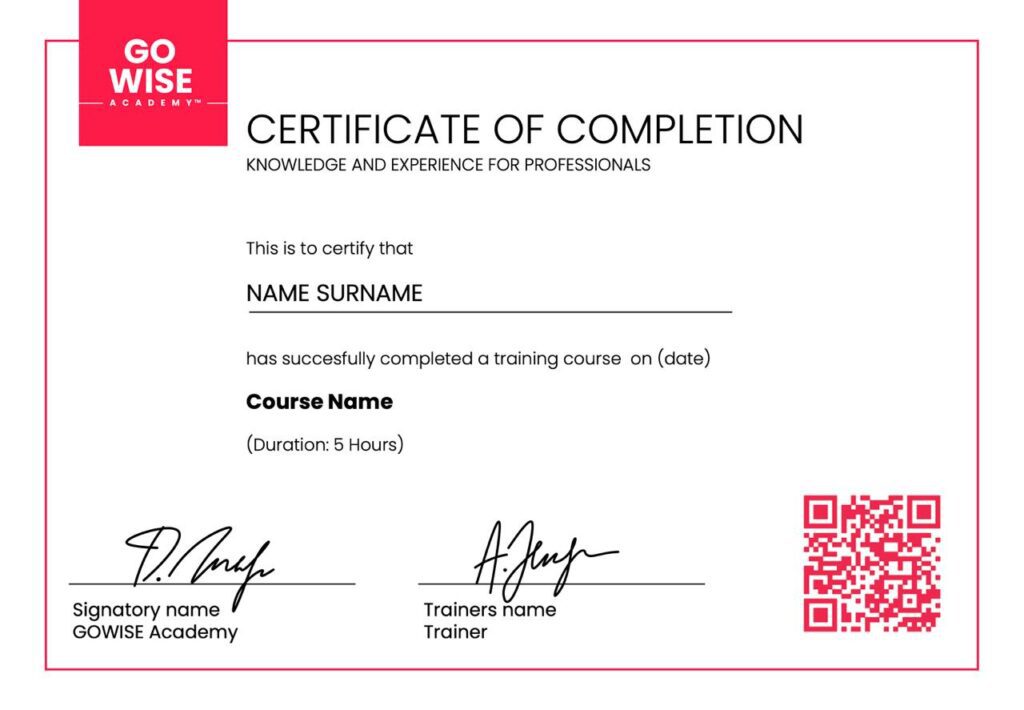
Certificate of Completion

Receive a certificate of completion to showcase your achievement and enhance your professional credentials upon finishing the course.

160,00 

Rate this course

No Review Yet
No Review Yet

Course features

Certification

Receive a proof of learning with verified course certificate​

FAQs

Do I receive a certificate after completing the course?

Yes! Upon successful completion of the course and any required assessments, you will receive a certificate of completion. This certificate can be downloaded and shared on your professional profiles or with potential employers.

Courses are delivered entirely online through a mix of video lectures, interactive activities, downloadable resources, and optional live sessions, making learning engaging and flexible.
Most of our courses have no fixed deadlines, allowing you to complete them at your own pace. However, some live or cohort-based programs may have set schedules, which will be clearly mentioned
Yes! Once you enroll, you’ll have access to the course materials up to 5 years, including video lectures, resources, and downloadable content, so you can revisit them anytime.

All course materials, including video lectures, PDFs, and assignments, will be available on our online learning platform. You can log in anytime from your computer, tablet, or smartphone.

Our courses are accessible on all modern devices, including laptops, tablets, and smartphones. All you need is an internet connection, and you can learn anytime, anywhere.

Recommended for You

Continue your progress with related courses designed to deepen your skills.