

Liquidity Requirements under Basel Capital Framework and CRR (LCR & NSFR) – Advanced Level

Liquidity Requirements under Basel Capital Framework and CRR (LCR & NSFR) – Advanced Level

About this course

This liquidity training program adopts a hands-on approach, combining key theoretical concepts with practical exercises focused on regulatory liquidity requirements, including the Liquidity Coverage Ratio (LCR) and Net Stable Funding Ratio (NSFR) under the Basel capital framework and Capital Requirements Regulation (CRR)

  • Explain the concepts, purpose, and regulatory significance of liquidity prudential requirements under the Basel Capital Framework and CRR.
  • Describe the step-by-step methodology used to calculate the Liquidity Coverage Ratio (LCR).
  • Identify and understand the components of High-Quality Liquid Assets (HQLA) used in LCR calculations.
  • Analyze how total net cash outflows are determined under regulatory stress scenarios for LCR.
  • Demonstrate the formula and computation process for the Net Stable Funding Ratio (NSFR).
  • Examine the classification of Available Stable Funding (ASF) and Required Stable Funding (RSF) in NSFR calculations.
  • Interpret regulatory thresholds and understand how calculated ratios reflect a bank’s liquidity position.
  • Provide practical examples illustrating the calculation process for both LCR and NSFR.

  • Understanding how to calculate LCR and NSFR
  • Identifying key components used in both ratios
  • Interpreting liquidity ratios for decision-making
  • Supporting regulatory compliance
  • Improving liquidity risk awareness

Course Curriculum

1. Overview of Liquidity Coverage Ratio (LCR) Requirements
• Liquidity coverage ratio (LCR) minimum requirements • Liquidity coverage ratio (LCR) components • Defined thresholds for High-Quality Liquid Assets (HQLA) reserve components

  • Overview of Liquidity Coverage Ratio (LCR) Requirements and components
  • GOWISE Academy: Likviditātes prasības saskaņā ar CRR (LCR un NSFR)

2. High-Quality Liquid Assets (HQLA)
• Definition and fundamental characteristics of HQLA • Operational requirements for HQLA • Level 1 liquid assets • Level 2 liquid assets (2A and 2B liquid assets)

3. Total Net Cash Outflow Calculation Requirements
• Categories of cash outflows and inflows, and supervisory factors • Definition of residual maturity for liabilities and assets • Definition and determination of stable and operational deposits • Simplified approach for small and non-complex banks

4. Overview of Net Stable Funding Ratio (NSFR) Requirements
• Nest Stable Funding Ratio (NSFR) minimum requirements • Nest Stable Funding Ratio (NSFR) components • Definition of Available Stable Funding (ASF) and Required Stable Funding (RSF)

5. Available Stable Funding (ASF) Calculation Requirements
Available Stable Funding (ASF) categories and supervisory factors

6. Required Stable Funding (RSF) Calculation Requirements
Required Stable Funding (RSF) categories and supervisory factors

7. Conclusions and Q&A
• Summary of key learning points • Frequently asked questions and answers • Additional resources and next steps

Check Your Understanding
Complete this multiple-choice quiz to test your knowledge—achieving a passing score will qualify you to receive your course completion certificate.

Target Audience

  • Treasury and Liquidity Management Teams
  • Risk Management Professionals
  • Finance and Regulatory Reporting Teams
  • Internal Audit Professionals
  • Senior Management and Decision Makers

Videos and Seminar Notes

Access comprehensive seminar videos and notes that cover topics delivered during the sessions, helping you review and deepen your understanding at your own pace.

Quiz

Test your knowledge with interactive quizzes designed to reinforce learning and ensure you're on track with the course material.

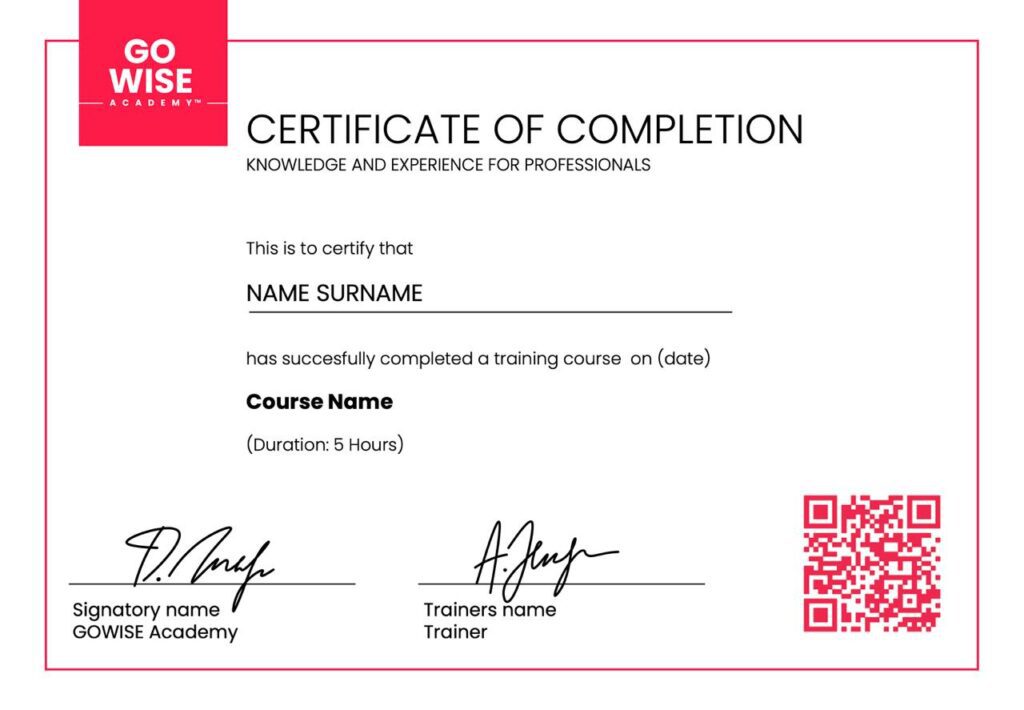
Certificate of Completion

Receive a certificate of completion to showcase your achievement and enhance your professional credentials upon finishing the course.

220,00 

Rate this course

No Review Yet
No Review Yet

Course features

Certification

Receive a proof of learning with verified course certificate​

FAQs

Do I receive a certificate after completing the course?

Yes! Upon successful completion of the course and any required assessments, you will receive a certificate of completion. This certificate can be downloaded and shared on your professional profiles or with potential employers.

Courses are delivered entirely online through a mix of video lectures, interactive activities, downloadable resources, and optional live sessions, making learning engaging and flexible.
Most of our courses have no fixed deadlines, allowing you to complete them at your own pace. However, some live or cohort-based programs may have set schedules, which will be clearly mentioned
Yes! Once you enroll, you’ll have access to the course materials up to 5 years, including video lectures, resources, and downloadable content, so you can revisit them anytime.

All course materials, including video lectures, PDFs, and assignments, will be available on our online learning platform. You can log in anytime from your computer, tablet, or smartphone.

Our courses are accessible on all modern devices, including laptops, tablets, and smartphones. All you need is an internet connection, and you can learn anytime, anywhere.

Recommended for You

Continue your progress with related courses designed to deepen your skills.