
Mastering Basel Capital Framework: Capital Requirements Explained

Mastering Basel Capital Framework: Capital Requirements Explained

About this course

Learn capital adequacy management principles for identifying, measuring, monitoring, and managing risks impacting a bank’s capital position under the Basel capital framework. This capital adequacy training program is designed with a hands-on approach, integrating essential theoretical concepts of regulatory capital management with practical exercises.

  • Gain a clear understanding of the Basel Capital framework structure, including minimum capital requirements, capital buffers, and the composition of eligible capital.
  • Learn how to compute risk-weighted assets for credit risk exposures.

  • Explore eligible forms of credit risk mitigation—including funded and unfunded protection—and understand how CRM techniques affect capital requirements.

  • Understand the own funds requirements for operational risk and learn how to apply criteria for identifying, collecting, and treating internal loss data.

  • Examine the delineation between banking and trading books, and understand the approaches to calculating market risk capital: Simplified Standardised, Sensitivity-Based Standardised, and Internal Models (including key requirements).

  • Improve participants’ professional efficiency and decision-making processes.

  • Understanding of Basel capital framework structure and regulatory capital components.
  • Overview of risk-weighted asset (RWA) calculations for credit, market, and operational risk.
  • Familiarity with credit risk mitigation techniques and their role in capital requirements.
  • Basic interpretation of capital buffers, minimum requirements, and regulatory thresholds.
  • General awareness of internal loss data considerations for operational risk.
  • Foundational insights to support compliance, reporting, and strategic discussions.

Course Curriculum

1. Overview of Basel Capital Framework
Basel Capital Framework covering regulatory minimum capital requirements, buffers above the minimum requirements, and the key elements of capital requirements.

  • Comprehensive overview of the Basel Capital Framework and its evolution

2. Definition of Eligible Capital
Overview of Common Equity Tier 1 (CET1), Additional Tier 1 (AT1), and Tier 2 capital instruments.

3. Capital Requirements for Credit risk
Calculation of Risk Exposure Value (including conversion factors for off-balance sheet items), application of external credit assessments with practical examples, and a comparison of the Standardised and Internal Ratings-Based approaches with practical examples.

4. Credit Risk Mitigation Techniques – Eligible Approaches
Overview of funded and unfunded credit protection.

5. Capital requirements for Counterparty Credit risk (CCR) and Credit Valuation Adjustments (CVA)
Overview of methods to calculate CCR risk-weighted assets and CVA exposure value

6. Capital requirements for Operational risk
Overview of own funds requirements for operational risk, Internal Loss Multiplier – criteria on loss data identification, collection and treatment.

7. Calculation of RWA for Market risk
Boundary between the banking book and the trading book, Simplified Standardised Approach – overview, Standardised Approach: sensitivity based method – overview, Internal models approach requirements – overview.

Check Your Understanding
Complete this multiple-choice quiz to test your knowledge—achieving a passing score will qualify you to receive your course completion certificate.

Target Audience

  • Risk Management and Compliance Teams
  • Internal Audit and Regulatory Reporting Staff
  • Finance and Strategy Analysts
  • Senior Management and Decision Makers

Videos and Seminar Notes

Access comprehensive seminar videos and notes that cover topics delivered during the sessions, helping you review and deepen your understanding at your own pace.

Quiz

Test your knowledge with interactive quizzes designed to reinforce learning and ensure you're on track with the course material.

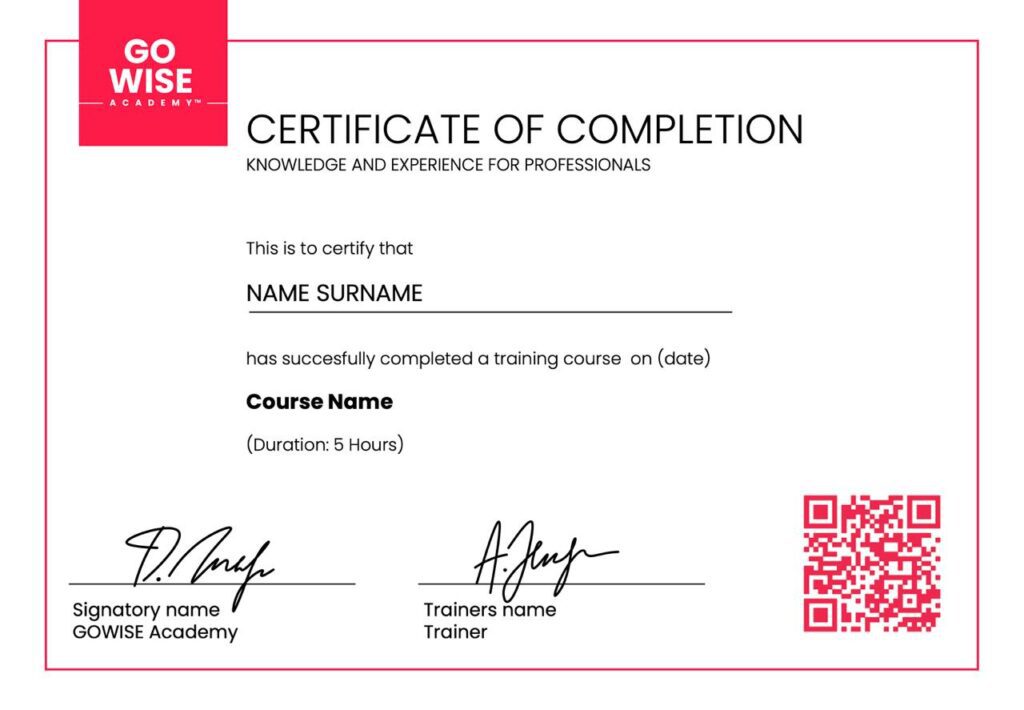
Certificate of Completion

Receive a certificate of completion to showcase your achievement and enhance your professional credentials upon finishing the course.

125,00 

Rate this course

No Review Yet
No Review Yet

Course features

Certification

Receive a proof of learning with verified course certificate​

FAQs

Do I receive a certificate after completing the course?

Yes! Upon successful completion of the course and any required assessments, you will receive a certificate of completion. This certificate can be downloaded and shared on your professional profiles or with potential employers.

Courses are delivered entirely online through a mix of video lectures, interactive activities, downloadable resources, and optional live sessions, making learning engaging and flexible.
Most of our courses have no fixed deadlines, allowing you to complete them at your own pace. However, some live or cohort-based programs may have set schedules, which will be clearly mentioned
Yes! Once you enroll, you’ll have access to the course materials up to 5 years, including video lectures, resources, and downloadable content, so you can revisit them anytime.

All course materials, including video lectures, PDFs, and assignments, will be available on our online learning platform. You can log in anytime from your computer, tablet, or smartphone.

Our courses are accessible on all modern devices, including laptops, tablets, and smartphones. All you need is an internet connection, and you can learn anytime, anywhere.

Recommended for You

Continue your progress with related courses designed to deepen your skills.